
Research and Publications
goGOGOgo is an innovation, knowledge and research hub which generates and manages programmes aimed at improving the health outcomes and life opportunities of gogos and the children they are raising.
digital learning for older adults
‘In wisdom I am strong but in technology I am weak’: The role of iGOGO in developing digital literacy and skills among older women in South Africa. 2025
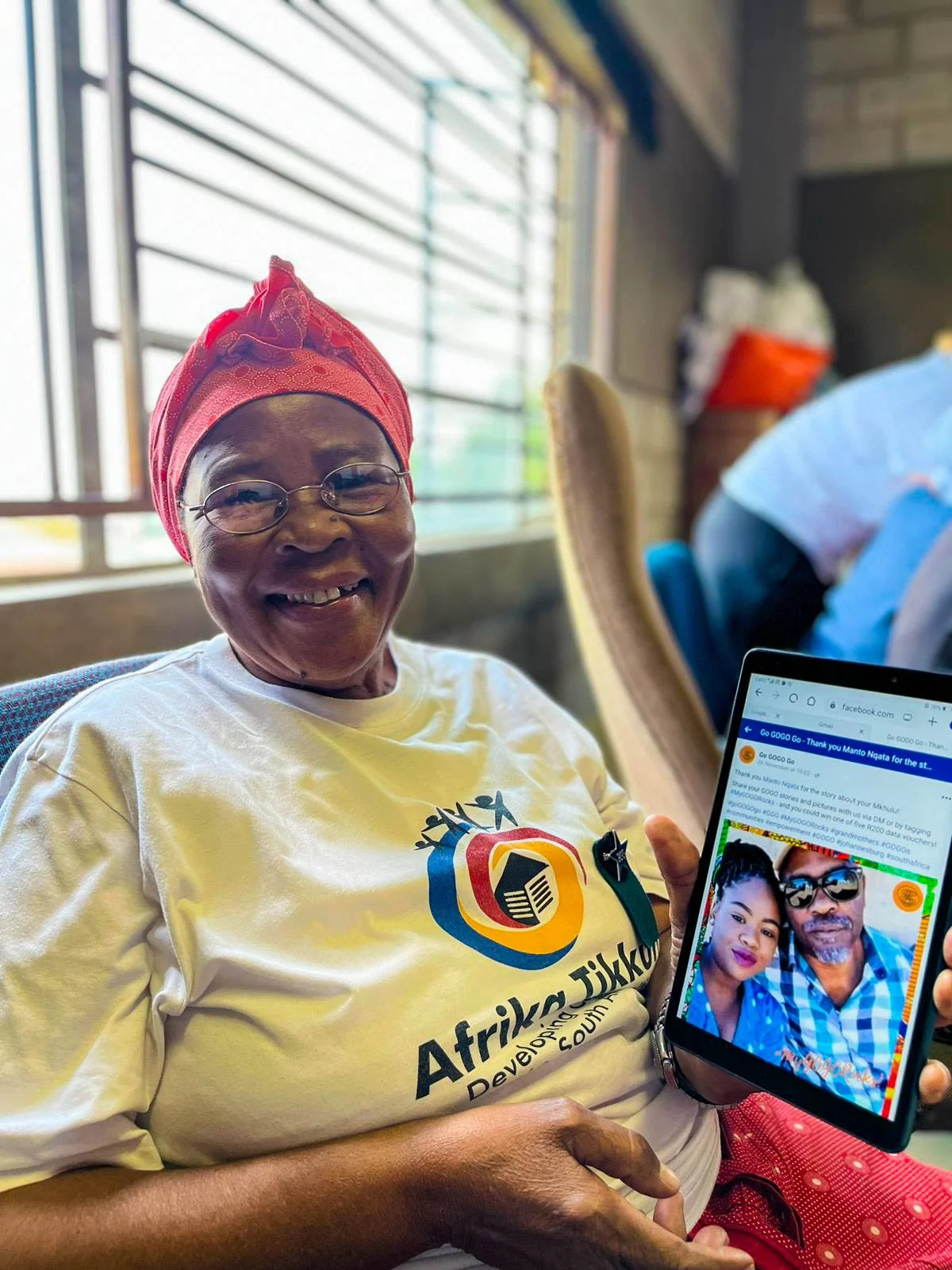
‘In wisdom I am strong but in technology I am weak’: The role of iGOGO in developing digital literacy and skills among older women in South Africa. del Pilar García-Chitiva and Simmonds (2025) in “Bridging the Grey Digital Divide: Enhancing ICT Learning for Older Adults”. p19-20. UNESCO Institute for Lifelong Learning, Shanghai Open University, Institute for the Future of Education.
goGOGOgo co-authored a chapter detailing the iGOGO project as a case study contributing to a global understanding of how to embed digital learning for older adults within national lifelong learning systems
“Bridging the Grey Digital Divide: Enhancing ICT Learning for Older Adults”, a research report co-implemented by the UNESCO Institute for Lifelong Learning (UIL), Hamburg and the Institute for the Future of Education (IFE), Monterrey, explores how organisations across six countries – Bahrain, Chile, China, Poland, South Africa and the United States of America – are advancing digital learning for older adults.
Our chapter, ‘In wisdom I am strong but in technology I am weak’: The role of iGOGO in developing digital literacy and skills among older women in South Africa, highlights the importance of culturally grounded, intergenerational and participatory methods. The chapter explores the iGOGO programme as a case study for how to equip older adults with the practical digital skills, confidence and support needed to participate fully in an increasingly digital society.
sexual & reproductive health communication
“Knowledge I seek because culture doesn’t work anymore … It doesn’t work, death comes”: the experiences of third-generation female caregivers (gogos) in South Africa discussing sex, sexuality and HIV and AIDS with children in their care

Simmonds, J.E., Parry, C.D.H., Abdullah, F. et al. “Knowledge I seek because culture doesn’t work anymore … It doesn’t work, death comes”: the experiences of third-generation female caregivers (gogos) in South Africa discussing sex, sexuality and HIV and AIDS with children in their care. BMC Public Health21, 470 (2021). https://doi.org/10.1186/s12889-021-10494-5
goGOGOgo’s founder Jane Simmonds co-authored this study which focuses on gogo’s who are the primary caregivers of their grandchildren and therefore responsible for talking to them about sex, sexuality, and HIV.
SummaryBackground
Sexual reproductive health communication between parents and children has been shown to promote safer sexual choices. In many South African households, third-generation female caregivers, often grandmothers or other older females, locally known as gogos, are primary caregivers of children due to parents being deceased or absent. Subsequently, the responsibility of talking about sex and related issues has shifted to these gogos. This study explored the experiences of gogos living in Alexandra, Johannesburg on talking about sex, sexuality and HIV and AIDS with children aged 10–18 years that are in their care.
Methods
Ten primary caregivers were purposively selected. Data were collected through in-depth individual interviews. Thematic analysis was performed and inductive codes and themes identified.
Results
All gogos selected found it difficult to discuss sex, sexuality and HIV and AIDS due to culture and traditional values impacting on personal experiences as well as generation and gender barriers. Perceived low self-efficacy due to low levels of knowledge and limited skills in speaking about sex, sexuality and HIV and AIDS also contributed to low levels of sexual reproductive health communication.
Conclusions
This study highlights the need for interventions that focus on improving gogos’ knowledge about sexual reproductive health in addition to providing them with the skills to talk about sex, sexuality and HIV and AIDS with children in their care.
conferences
goGOGOgo presented at the following conferences
Public Health Association of South Africa Conference, 2025.
go to website
Aging & Social Change Fifth Interdisciplinary Conference 2025 (Sweden).
go to website
International Federation on Aging 17th Global Conference on Aging 2025 (Cape Town).
go to website
statistics and graphs

all publications
UNESCO Institute for Lifelong Learning. (2025). Bridging the grey digital divide: Enhancing ICT learning for older adults. UNESCO. https://unesdoc.unesco.org/ark:/48223/pf0000396040
Iwu-Jaja, C., Jaca, A., Simmonds, J., Parry, C., & Wiysonge, C.S. (2024). A rapid review of research conducted on diseases and conditions impacting older persons in South Africa. Pan African Medical Journal, 14(5). doi.org/10.11604/pamj-oh.2024.14.5.41831
Katoto PDMC, Parker S, Coulson N, Pillay N, Cooper S, Jaca A, Mavundza E, Houston G, Groenewald C, Essack Z, Simmonds J, Shandu LD, Couch M, Khuzwayo N, Ncube N, Bhengu P, Rooyen HV, Wiysonge CS. Predictors of COVID-19 Vaccine Hesitancy in South African Local Communities: The VaxScenes Study. Vaccines (Basel). 2022 Feb 25;10(3):353. doi: 10.3390/vaccines10030353. PMID: 35334991; PMCID: PMC8951818 https://pubmed.ncbi.nlm.nih.gov/35334991/
Simmonds, J., Parry, C, & Freeman, M. (7/7/20). South Africans must be healthier for universal healthcare to succeed. The Conversation. https://theconversation.com/south-africans-must-be-healthier-for-universal-healthcare-to-succeed-140204
Parry, C.D., Simmonds, J.E., & Freeman, M. (2020). Failing to respond to health promotion imperatives could scupper or hamper NHI efforts. SAMJ, 110, 170-171. https://doi.org/10.7196/J.2020.110i3.14497
Freeman, M., Simmonds, J.E., & Parry, C.D. (2021). Health promotion: How government can ensure the NHI has a fighting chance. SAMJ, 110, 188-191. https://doi.org/10.7196/SAMJ.2020.v110i3.14499
Simmonds, J., Parry, C., Burnhams, N., Abdullah, F., & Christofides, N. ‘“Knowledge I seek because culture doesn’t work anymore … It doesn’t work, death comes”: Perceptions and experiences of third generation female caregivers (“gogos”) in South Africa on sexual reproductive health communication with children in their care’ BMC, 2021, https://pubmed.ncbi.nlm.nih.gov/33750336/
“The perceived impact of a skills training workshop supported by the book, HIV & AIDS, on grandmothers’ communication with pre-adolescent and adolescent grandchildren in their care about sex, sexuality and HIV and AIDS in Alexandra”: Masters in Public Health Dissertation, School of Public Health, University of the Witwatersrand, 2016